
Growing up, I was taught that our nation’s freedom struggle achieved success only because of a few individuals, most notably Mohandas Karamchand Gandhi, Jawaharlal Nehru, and Vallabhbhai Patel. These men, our NCERT books explained, initiated several non-violent movements that compelled the British government to give up its “Crown Jewel”, i.e. India. Later, I discovered stories of our revolutionaries and there was a complete shift in perspective. Around the same time, I also delved deep into the history of World War II and realized the half-baked propaganda present in our school’s history books.
In particular, I noted the following flaws in the mainstream narrative of our freedom movement:
- Focusing too much on various non-violent movements and putting less emphasis on the impact of the violent actions of armed revolutionaries.
- Completely ignoring the cunningness and ruthlessness with which the British officers ruled Indians. We were never told (in great detail) about the massive atrocities inflicted by the British colonial administration on India’s poor population.
- Not explaining the enormous influence of the ever changing international situation on the freedom movement. This is perhaps the greatest mistake because it is impossible to understand the various shades of our anti-colonial struggle if we ignore the waves of international politics.
Why weren’t the history books written in an impartial manner, giving proper importance to every form of our independence movement? The reason is simple: domestic politics and the desire to please international audiences. However, times have now changed and there are a growing number of books being published that challenge the currently dominant narrative.
There is a theory called “Safety Valve Theory”. It was propounded by Lala Lajpat Rai in a book titled “Young India” in 1916. In this theory, he described the Indian National Congress (INC) as a “Safety Valve” created by the British administration. The INC was to act as a platform for Indians to raise their grievances through peaceful means. Consequently, there would be no violent uprising like the 1857 revolt against the British rulers. In 1938, C F Andrews and Girija Mukherji supported this theory in their book titled “The Rise and Growth of the Congress in India”.
Although modern historians reject this theory, there are ample grounds to believe in it. Here are a few points that we can consider:
- Formation of INC by A O Hume who was a retired British ICS officer. In a letter (1883) to Lord Dufferin, he warned of a “conspiracy of silence” among educated Indians and suggested that they must be driven into “safe political channels”.
- Early leaders of INC such as Dadabhai Naoroji and W C Bonnerji were moderates and they pledged loyalty to the British crown before seeking “justice” within constitutional boundaries.
- Lord Dufferin described INC as a “microscopic minority” that was very useful in “understanding Indian opinion”.
- The emergence of revolutionary groups such as Anushilan Samiti and India House (London) gave British rulers more incentive to promote INC as a “constitutional alternative”.
By 1920, however, INC was transformed by Mohandas Karamchand Gandhi and he took the freedom struggle to the impoverished Indian masses. He launched many non-violent movements but none of them were successful enough to secure even a simple dominion status. India became a dominion only in 1947 by the passage of the Indian Independence Act. Britain was strategically playing political games (E.g. Round Table Conferences) with Gandhi thereby consistently delaying India’s independence.
The decisive factor that led to India’s Independence is the Second World War. This war drained British resources and manpower like never before in history. Beginning in 1939, the war broke the willpower of British rulers, and for the first time, they experienced the constant threat of full scale invasion of their homeland by Nazi Germany.
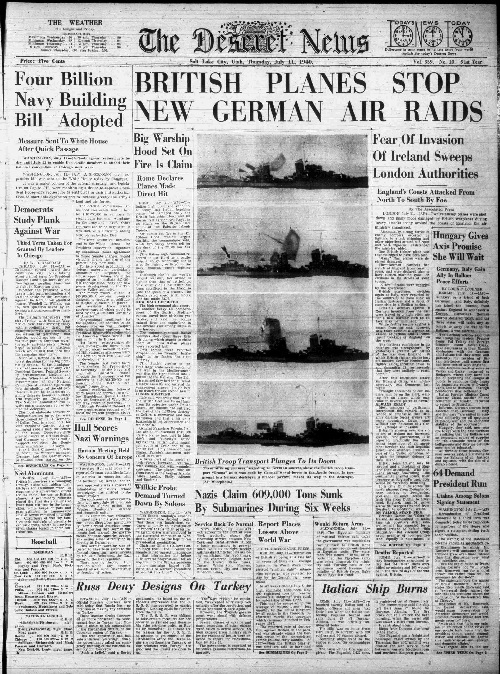
Newspaper Report Mentioning the Invasion of UK (1940) by Nazi Germany’s Fighter Planes [Image Credit: Deseret News]
One major defeat during WWII that the UK suffered hugely impacted its prestige among all its colonies including India. That was the Fall of Singapore (1942). In this battle, Japanese forces crushed British troops and occupied Singapore. The defeat of the UK by an Asian power demolished the illusion of White man’s supremacy. It raised the confidence of subjugated people among all colonies and foreshadowed the end of European empires. Although the UK did emerge victorious at the end of WWII in 1945, it could no longer project the required strength, tenacity, and resources to maintain its hold over a huge colony like India.
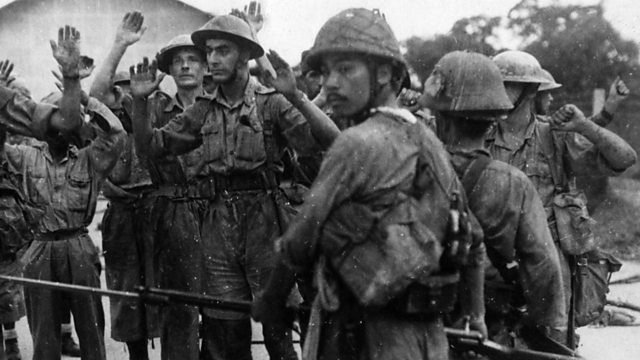
Japanese Troops Capture Commonwealth Military Personnel in Singapore (1942)
By the end of WWII in 1945, India was remarkably different from what it was in 1939. Here are a few examples:
- More than 2.5 million Indian soldiers fought for the Allies- the largest volunteer army in history. Note that the British had enacted the Indian Arms Act (1878) to restrict the possession of arms and ammunition by Indians. WWII changed the entire scene- more than 2.5 Indian men were fully armed and prepared to launch into any conflict. After the war, these men began asking the pertinent question- “Why should I live under foreign rule when I have secured freedom for several nations from Axis oppression through my own blood?”
- The 1943 Bengal famine led to widespread discontent against the British regime and it effectively damaged the propaganda that the foreign rule was “benign” for India. This famine convinced various Indian leaders that ensuring food security had to be the foremost priority after independence.
- Wartime demands led to massive industrialization across various sectors like steel, textiles, chemicals, weapons, and engineering goods. India became self-sufficient industrially to a great extent, laying the groundwork for post-independence economic growth.
- During the war, thousands of allied servicemen from different countries such as the US, Australia, Canada, New Zealand arrived in India. They set up airfields, roads, training camps, and supply lines to fight against the Japanese. Interaction with these allied military personnel exposed ordinary Indians to citizen rights, democratic practices, and anti-colonial thoughts. They began to see British rule in a different light- more harsh, oppressive, and dictatorial.
Netaji Subhas Chandra Bose also took advantage of WWII by reorganizing the Indian National Army and attacking the British colonial forces stationed in India. The global geopolitics had also changed irreversibly by 1945- Soviet Union and US emerged as new superpowers. Both were against the continuation of the British empire and wanted it to dissolve as soon as possible. The UK had to submit to the authority of the US to survive against the mighty Soviet Union in the emerging Cold War.
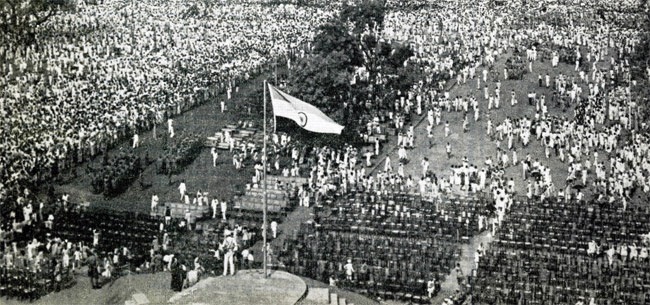
Independence Day Celebrations in New Delhi, India on 15 August 1947
In conclusion, we can say that India’s independence in 1947 was largely a result of an altered international situation created by WWII. The INC and all the revolutionaries did play a role but that wasn’t powerful enough to evict the British rulers. At best, the INC provided a set of leaders that were ready to accept the transfer of power in 1947. These facts are not taught to school and university students because they are contrary to the narrative that all the political parties in India want to project. As George Orwell observed, “Who controls the past controls the future. Who controls the present controls the past.”
References:
- Chandra, B. (1988). India’s Struggle for Independence
- Dutt, R. P. (1940). India Today
- Majumdar, R. C. (1963). The History of the Freedom Movement in India (Vol. I)
- Rai, L. L. (1917). The Political Future of India
- Khan Yasmin (2015). The Raj At War: A People’s History of India’s Second World War