
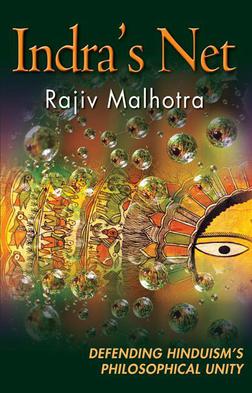
While reading about the Vedanta philosophical tradition, I came across a Wikipedia article titled “Neo-Vedanta”. Intrigued, I started researching the entire topic, and that led me to this wonderful book. If you read this book, you will begin to understand the evolution of Hinduism in response to colonization and other interrelated factors.
Note: This book was first published in 2014, and a revised edition was later released in 2016. Since I have the 2014 edition, this review pertains to that version.
Detailed Review
Divided into two parts, this book is a bold & passionate attempt by the author to challenge the idea commonly prevalent in Western academic circles that Hinduism does not have any philosophical unity and it is merely a loose collection of fragmented traditions. Supporters of this idea also claim that it was Swami Vivekananda who “manufactured” Hinduism in the late 19th century by borrowing Western thoughts.
The title “Indra’s Net” comes from the Atharva Veda and it refers to the entire world as a cosmic web where every node reflects all other nodes. At each node, there is a jewel, and no jewel can exist independently. Everything is connected to everything else. Malhotra uses this metaphor to argue that:
- Hindu philosophy has underlying unity and complete coherence.
- Though there is some influence of Western ideas in modern Hinduism, the majority of resources involved in bringing change came from the tradition itself.
- Contemporary Hinduism does not oppress any social or religious group; rather, it can be an incredible gift to entire humanity.
In the first part of this work, named Purva Paksha, the author has examined the arguments presented by the proponents of the “Neo-Hinduism” theory. Some of the leading thinkers that are mentioned here include Paul Hacker, Agehananda Bharati, Ursula King, and her student Anantanand Rambachan, Richard King, Sheldon Pollock, etc. Moreover, I found that the author has also named some Hindu leaders, such as Shamita Basu and Frank Morales, who have spoken and written in favour of this theory. Malhotra manages to uncover the hidden motivations and biases that supporters of this thesis seem to carry.
When you reach the next part of this book, titled Uttara Paksha, you can read the strong response offered by the author to all the thinkers of the neo-Hinduism theory. Interestingly, the author has focused on Vijnanabhikshu who was a Hindu philosopher in the pre-colonial era. Malhotra claims that this philosopher unified Vedanta, Yoga, and Samkhya, and all the early British scholars studied his works before formulating the neo-Vedanta thesis. The author also states that Hindu leaders, such as Vivekananda and Sarvapalli Radhakrishnan, were also influenced by Vijnanabhikshu.
In the next few chapters, I discovered that the author has explained how social service was always an integral part of Hindu tradition. He counters the arguments put forward by various scholars that Swami Vivekananda copied a Western model of social activism to start seva through the Ramakrishna Mission. Malhotra has also attempted to show the inherent unity of Vedanta and Yoga in the Hindu philosophical tradition. Later, he presents contemporary Hinduism as an “Open Architecture” model that also retains its essential ancient core.
The author concludes his book by offering a few “Poison Pills” for the protection of Hinduism. According to Malhotra, a “Poison Pill” is a traditional concept (or element) that can never be digested by any predatory cult. He proposes that the concepts of Karma, Reincarnation, and Jivanmukta (Living Enlightened Teacher) can protect Hinduism from any culture that seeks to digest Hindu knowledge systems. Furthermore, the author has called upon contemporary Hindu leaders to develop awareness of rival religions in order to successfully counter various challenges.
Final Words
When I finished reading this work, I found that I could easily comprehend the contemporary Hindu movements prevailing across the globe. It was quite fascinating to unravel the history of Hinduism’s evolution from the time of British colonization to the present era. In my opinion, most arguments put forward by the author are satisfactory. However, he also does not seem inclined to accept the fact that the colonial influence over Hinduism is markedly different from earlier invasions. Although Hinduism has always evolved, the British colonialists attempted to rewrite the essential history and philosophy of Hinduism— something that was never done by earlier foreign invaders. In some respects, therefore, Malhotra seems less effective while analyzing the Western influence over Hinduism’s evolution.
Overall, this book is quite good, and one must read it to develop a deeper understanding of contemporary Hinduism.
About the Author
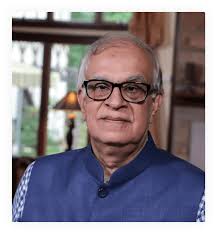
Rajiv Malhotra (born 1950) is an Indian-American Hindu scholar and the founder of the Infinity Foundation. He has written numerous books and articles to expose the flaws in western academic study of Indian culture and civilization. Some of his notable works include Breaking India (2011), Being Different: An Indian Challenge to Western Universalism (2011), The Battle for Sanskrit (2016), and Artificial Intelligence and the Future of Power (2021).